For Later Beginners
By Willard A. Palmer, Morton Manus, and Amanda Vick Lethco
Core Books: Lesson, Theory, Technic
Supplementary Instructional Books: Activity & Ear Training, Notespeller, Sight-Reading
Supplementary Performance Books: Fun Solos, Hymns, Merry Christmas, Praise Hits, Repertoire, Top Hits!, Top Hits! Christmas
Description
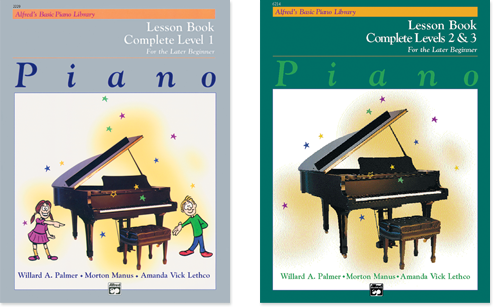
Alfred's Basic Complete Level 1 is designed to appeal to a student who starts piano study later than the average beginner. It could also be used for a young student who shows unusual musical aptitude and needs a quicker pace. This one book presents all the concepts introduced in Alfred’s Basic, Lesson Books 1A and 1B. The student moves more quickly to the grand staff, and the book progresses at a faster pace.
The Alfred's Basic Complete Level 2/3 Lesson Book presents all the concepts introduced in Alfred’s Basic Lesson Books 2 and 3. This book, like Alfred's Basic Complete Book 1, progresses at a faster pace.
Outline of Concepts in Complete Lesson Book 1
Black Keys (Pages 5–7)
Black keys are used for keyboard orientation and finger number recognition, while still avoiding the association of any finger number with a specific key. Tunes are played on the black keys for rhythmic reading and development of finger skills. Two basic dynamic signs ( p and f ) and whole notes are introduced.
White Keys and Middle C Position (Pages 9–11)
Fluent recognition of white key names through letter-notes in Middle C position that move up or down on the page as if they were on a staff. This visual concept helps prepare the student for staff notation. 4/4 time signature and a new dynamic sign ( mf ) are introduced.
Grand Staff and C Position (Pages 12–17)
Students are introduced to the bass & treble clef, the bass & treble staff, and the grand staff. Students are able to practice reading in C position on the grand staff, using the hands alternately.
Intervals (Pages 18–31)
Students are provided with practice reading intervals in C position, including 2nds, 3rds, 4ths, and 5ths. There is a discussion about the difference between harmonic and melodic intervals. 3/4 time signature, legato, slurs, tied notes, and quarter & whole rests are all introduced and included in pieces, building skills in technique, rhythmic reading, and expressive playing.
G Position (Pages 32–41)
The student practices reading intervals in G position. C position is reviewed, and sharps & flats are introduced. Crescendo and diminuendo are added to the array of dynamics. Incomplete measures, staccato articulation, and accent signs are introduced.
Middle C Position on the Staff (Pages 42–50)
The student practices reading notes on the staff in Middle C position. New concepts in this section include tempo markings, fermatas, eighth notes, half rests, 2/4 time signature, ritardando, a tempo, and repeat signs.
G Position in a New Octave (Pages 51–57)
The student is introduced to a new G position where the left hand is played an octave higher. Development of skills in technic, rhythm, and dynamics are continued by using pedaling, 8va, and eighth rests.
Middle D Position (Pages 58–63)
Middle D position is introduced. Pieces played include half steps, whole steps, and natural signs to continue developing technical skills.
Tetrachords and Major Scales (Pages 64–70)
The student is introduced to tetrachords and building major scales in C major & G major. The G major key signature is introduced. To continue development of technical, rhythmic, and dynamic skills, there is a piece with two left hand positions, and a piece with two right hand positions.
Final Review (Pages 71–72)
This section includes a final review of musical terms and a certificate of promotion to the next level.
What Makes Alfred’s Basic Piano Complete Course Special?
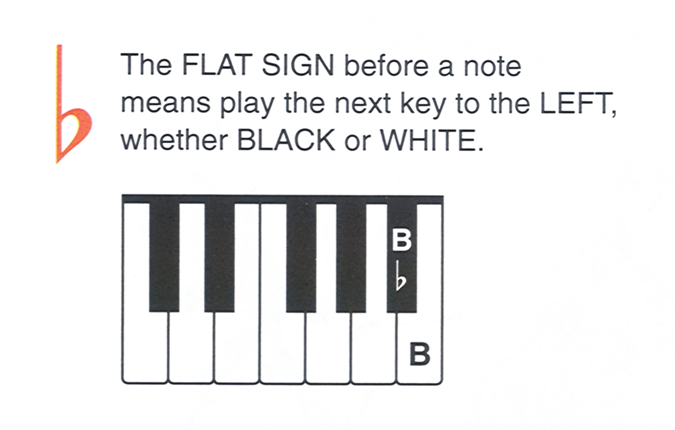
1. New musical terms or symbols are enlarged and highlighted. The definition is simple, precise, and clear.
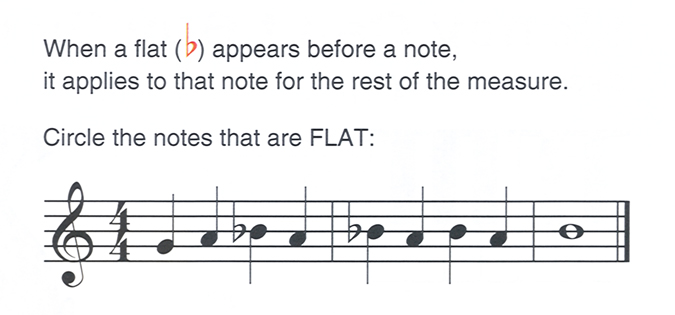
2. A simple exercise is sometimes presented that includes the new musical symbol.
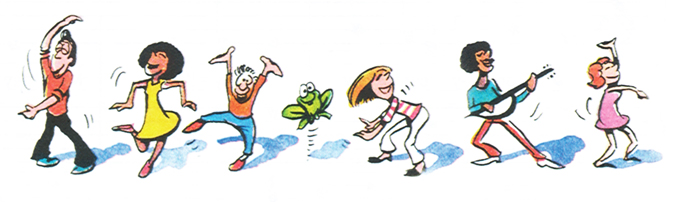
3. A colorful illustration accompanies nearly every piece and is related to the title, the lyric, or the rhythm of the piece. These illustrations are sure to bring a smile to the student's face and fun to the lesson.
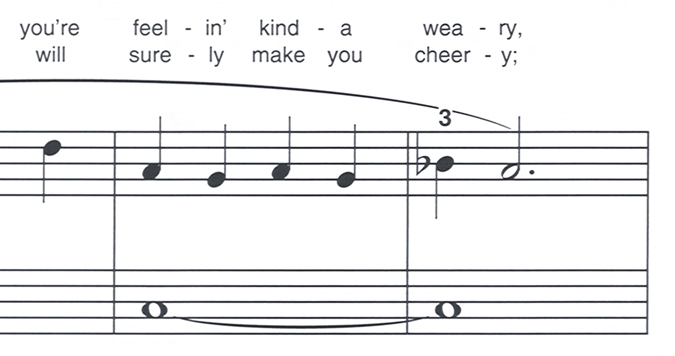
4. New musical symbols are identified in the music. First, the new musical symbol is defined. Then there is a short exercise using the new symbol. Lastly, the new musical symbol is included in a piece.
How Does the Complete Course Interact with the Basic Course?
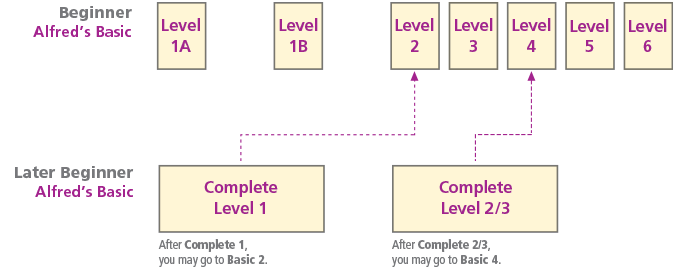
After completing the Complete Level 1, Lesson Book, if the teacher feels the student would benefit from a slower approach, a smooth switch can be made to Alfred’s Basic, Level 2.
- Find the Later Beginner Course below, then move right to the Complete, Level 1 box.
- Follow the dashed lines and arrows to see where the switch can be comfortably made.
- After completing Complete, Level 1, the student is ready to begin Alfred's Basic, Level 2.
- After completing Complete, Level 2/3, the student is ready to begin Alfred's Basic, Level 4.